Carlton is defined by its inter-war housing — street after street of 1920s and 1930s semis laid out across the eastern slopes of Nottingham, each with side passages, back gardens, and front boundaries that were planted up as part of the original development. Ninety years on, those plantings have matured into trees that now dominate their gardens, their plots, and in many cases their neighbours’ plots too. If you need a tree surgeon in Carlton, Nottingham, this guide covers everything from the specific species problems in NG4 to Gedling Borough Council’s TPO process, including the hedge disputes, HMO obligations, and fruit tree renovation questions we are most commonly asked about.
Tree Surgery Services in Carlton, NG4
TB Tree Care covers Carlton and the wider NG4 postcode area, including Netherfield, Colwick, and Carlton Hill. We provide:
- Crown reduction — safe, BS 3998-compliant reduction of height and spread
- Crown lifting and thinning — improving light and clearance without full reduction
- Tree felling and removal — from straightforward fells to confined-space section dismantles
- Stump grinding — below-ground removal of stumps to allow reinstatement
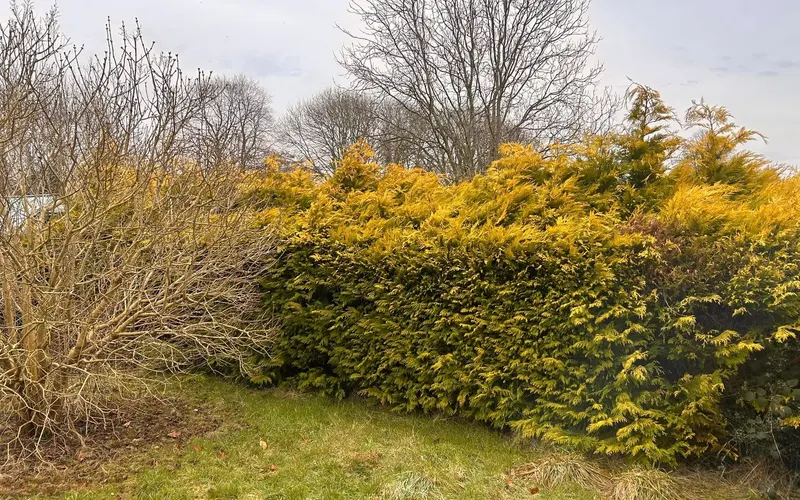
- Conifer and Leylandii reduction or removal — managing overgrown conifer hedges and specimen conifers
- Fruit tree renovation pruning — phased restoration of neglected apple, pear, and plum trees
- Deadwood removal — reducing storm risk in mature trees
- Emergency tree work — rapid response across NG4
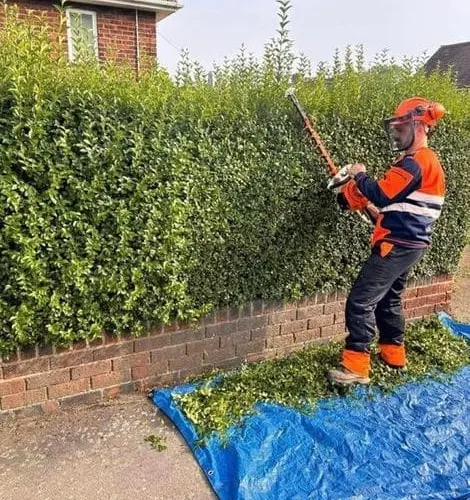
- Hedge cutting — including reduction of overgrown Leylandii and mixed boundary hedges
- Tree surveys and reports — condition assessments for insurance, HMO compliance, and planning
- TPO applications to Gedling Borough Council
What Was Planted in 1920s and 1930s Carlton Gardens — and Why It Matters Now
The inter-war developers who laid out Carlton’s residential streets planted boundary screening trees and ornamental specimens that were entirely manageable at the time. The Leyland cypress (×Cuprocyparis leylandii) did not exist as a cultivar until 1888 and only became widely commercially available from the 1950s, so the original planting era featured different species — cherry laurel, privet, hawthorn, and Norway spruce primarily. From the 1970s onwards, Leylandii was planted across Carlton in enormous quantities as a cheap, fast privacy screen, and those hedges and specimen trees are now often 8–15 metres tall.
Beyond Leylandii, the most significant mature planting in Carlton’s residential gardens includes:
- Horse chestnut — planted as front garden specimens in the 1930s and now frequently at the end of their productive life, many showing bleeding canker and leaf miner damage
- Flowering cherry (Prunus) — ubiquitous in Carlton’s front gardens; older specimens develop structural weakness at branch unions and are prone to catastrophic splitting in spring
- Self-seeded ash and sycamore — appearing along boundary fences and in corners of gardens, overlooked as seedlings and now significant trees requiring professional management or removal
- Apple and pear — fruit trees planted in back gardens of the original properties, often now 50–60 years old and severely neglected
- Bramley seedling — we see this variety frequently in Carlton’s back gardens; old specimens can develop structural complexity that requires staged renovation rather than a single-season intervention
The Leylandii Problem in Carlton
No tree type generates more disputes in Carlton’s tightly-packed residential streets than overgrown Leylandii. The legal position is clear under the Anti-social Behaviour Act 2003 (Part 8): a local authority can order the reduction of a hedge that is adversely affecting a neighbour’s reasonable enjoyment of their property if it is over 2 metres tall and is evergreen or semi-evergreen. However, the process is slow and the outcome uncertain — most disputes are better resolved by direct negotiation or professional mediation than through the council route.
The specific problem with tall Leylandii is biological: cutting back into the brown inner zone of a conifer that has not been maintained will not produce regrowth. Once a Leylandii hedge has been allowed to grow significantly beyond its optimal cutting height, the management options narrow to: maintain at the current height (no further reduction), or remove and replant with a more manageable species. We assess both options honestly and will tell you if your hedge is beyond salvageable reduction.
HMO Properties and Landlord Tree Obligations in Carlton
Carlton has one of the higher concentrations of Houses in Multiple Occupation (HMOs) in the East Midlands, particularly in the streets closest to the A612 and towards Nottingham city centre. When a residential property enters the HMO rental market, its garden often receives less active maintenance than it would under owner-occupation — and trees that might previously have been managed regularly can accumulate years of neglect.
For HMO landlords and their managing agents, tree condition is increasingly a compliance issue. Some local authorities now specifically reference external garden condition in HMO licensing requirements, and tree-related hazards — overhanging branches above the main access route, deadwood above car parking areas, leaning trees adjacent to the building — represent a genuine public liability exposure if not managed. We provide written tree condition reports suitable for inclusion in HMO compliance files and can carry out any recommended remedial works in the same visit.
Boundary Trees and Neighbour Disputes in NG4
Carlton’s close-set inter-war semis create a specific scenario for boundary trees: a sycamore or cherry planted on one side of a garden fence can easily spread its canopy over three or four adjacent plots within 20 years. The law gives you the right to cut back overhanging branches to the boundary line without needing your neighbour’s consent — but you must not enter their land to do so, and the cut material (including any fruit or seeds) remains their property.
What frequently goes wrong is the unilateral removal of large sections of canopy from one side only — which can create a structural imbalance that significantly increases the tree’s risk of failure in the next storm. We advise on boundary tree situations across NG4 and can facilitate a coordinated approach that achieves the required outcome for both parties while keeping the tree structurally safe.
Gedling Borough Council TPOs and Carlton
Carlton falls within Gedling Borough Council’s administrative area, and the council maintains a register of Tree Preservation Orders across NG4. Given the density of mature planting across Carlton’s residential streets, a meaningful proportion of significant trees carry protection — and some streets fall within or adjacent to conservation area boundaries where notification requirements apply regardless of TPO status.
Gedling Borough Council’s tree officers take an active interest in the mature tree stock across the borough. Applications for significant tree work in protected areas are assessed carefully, and supporting documentation — photographs, a condition assessment, a written reason for the proposed works — is routinely required. We prepare all consent applications and supporting material as part of our service.
Fruit Tree Renovation in Carlton Gardens
Renovation pruning of a neglected old apple or pear tree is a specialist task. The fundamental rule is that no more than 25–30% of the crown should be removed in any single season, and for trees that have been neglected for a decade or more the appropriate intervention should be spread over at least three seasons. Attempting to undo 20 years of neglect in one session causes significant stress and typically stimulates excessive water shoot (epicormic) growth that makes subsequent management harder, not easier.
We carry out phased fruit tree renovation programmes across NG4, working to a defined end-point and scheduling return visits to maintain the programme over the required timeframe. Where a fruit tree is beyond reasonable renovation — because the primary structure is compromised or the tree is simply at the end of its natural life — we will say so clearly and discuss replanting options.
Frequently Asked Questions — Tree Surgeon in Carlton
Can I cut my neighbour’s tree branches that overhang my garden in Carlton?
Yes — you have the legal right to cut back overhanging branches to the boundary line without needing permission from your neighbour or the council (assuming the tree is not TPO-protected or in a conservation area). However, the cut material must be offered back to the tree’s owner. Cutting back large sections unilaterally can cause structural problems — a professional assessment of the tree before any large-scale cutting is always advisable.
My Leylandii hedge is over 4 metres tall — what are my options?
At that height, the practical options are to maintain it at its current height (no further reduction), attempt reduction accepting there will be brown patches that may not recover, or remove and replant with a more manageable species. A site visit is the quickest way to assess which option is right for your hedge. We are honest about what is and is not achievable.
I’m a landlord with an HMO in Carlton — do I need a tree survey?
Not necessarily as a legal requirement, but a written tree condition report is increasingly best practice for HMO compliance files, particularly if there are mature trees near access routes or the building. We provide reports suitable for this purpose.
Do you cover Netherfield and Colwick as well as Carlton?
Yes — we cover the full NG4 postcode, including Carlton, Netherfield, Colwick, and Carlton Hill. We also cover Gedling village and Beeston. See our full area coverage page for all locations.
Need a tree surgeon in Carlton, Nottingham? Free site visits, NPTC qualified, fully insured. Experienced with Gedling Borough Council TPO applications, Leylandii management, and the specific tree challenges of Carlton’s inter-war housing stock.