Chalara ash dieback — caused by the invasive fungal pathogen Hymenoscyphus fraxineus — is the most significant tree disease to affect Britain since Dutch elm disease eliminated the elm from most of the UK’s landscape in the 1970s. It is now present across virtually all of England, including every part of Nottinghamshire, and the ash trees you can see from your garden, along the road, or in your local park are almost certainly already infected or exposed. This is not a reason to panic — but it is a reason to understand the disease properly and act on what you find. This guide covers ash dieback in Nottinghamshire: what it is, how to recognise it, what the structural risk implications are, and what your obligations are as a tree owner under current planning law.
What Is Ash Dieback (Chalara)?
Hymenoscyphus fraxineus is an ascomycete fungus originating in Asia that was introduced to Europe on infected nursery stock from the 1990s onwards. It was first confirmed in the UK in 2012 and has since spread to every corner of the country. The disease infects ash trees (Fraxinus excelsior, common ash) through spores released from fallen infected leaflets. The spores are windborne and can travel significant distances — there is no practical way to prevent infection in an ash tree that is exposed to the landscape.
The fungus colonises the vascular system of the tree, forming cankers — areas of dead tissue — in the bark and inner wood. As the cankers develop and coalesce, they cut off the flow of water and nutrients to sections of the crown above, causing progressive dieback. The tree responds by producing epicormic (water) shoots from lower on the stem, attempting to maintain photosynthetic capacity as the upper crown dies.
How to Identify Ash Dieback on Your Tree
The symptoms of Chalara are distinctive once you know what to look for. The visible signs vary across the growing season:
Summer Symptoms (June to September)
- Wilting and blackening of new shoot tips in June and July — this is the characteristic ‘dieback’ symptom, where new growth collapses and blackens as the fungus infects from below
- Diamond-shaped lesions on stems and branches at the point where dead shoot axes meet live bark — the bark around the dead shoot discolours and sinks inward
- Crown dieback progressing inward — in established infections, increasing sections of the crown fail to leaf out at the start of the season or die back during it
- Small white cup-shaped fruiting bodies on fallen blackened leaflets in August and September — these produce the spores that infect new trees
Winter Symptoms (October to February)
- Orange-brown discolouration of the bark at the base of dead shoots — a distinctive copper or rust colour visible after leaf fall
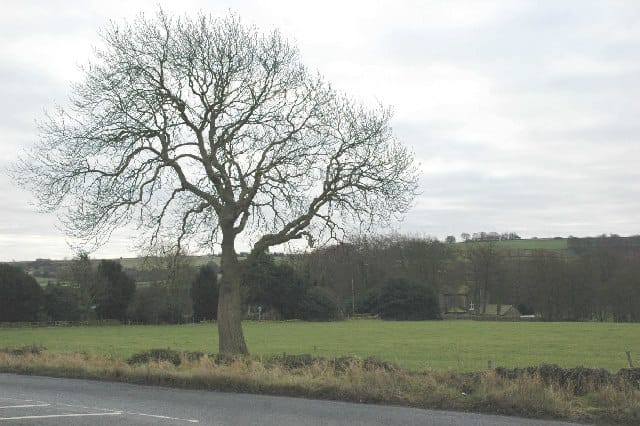
- Visible deadwood accumulation in the upper crown — a fully leafless winter ash should show uniform fine twig structure across the whole crown; sections with no fine twig structure indicate dieback
- Epicormic growth from the main stem and lower branches — dense clusters of shoots appearing in unusual positions indicate the tree is compensating for upper crown loss
The Structural Risk: What Changes as the Disease Progresses
The most important aspect of ash dieback for homeowners and tree owners to understand is what the disease does to the structural integrity of the wood — not just the visual health of the crown.
As Chalara progresses and sections of crown die, the wood in those dead sections does not dry and harden in the way that dead wood in a healthy tree would. The disease process itself compromises the cellular structure of the wood, leaving it brittle and mechanically unpredictable. This creates a specific risk pattern:
- Failures occur without the usual visual precursors of a healthy dead branch — there is no gradual drying and sagging; Chalara-affected branches can snap suddenly in moderate or even calm wind conditions
- Multiple failure events are common — once a tree enters mid-stage Chalara, the risk of branch failure is not limited to a single weak point but potentially across the whole dying crown section
- Stem failures are a concern in advanced cases — where Chalara has progressed to the main stem, including through associated secondary pathogens like Armillaria (honey fungus), the entire above-ground structure can become unstable
The practical implication is clear: an ash tree in the mid-to-late stages of Chalara that is near a building, public path, road, or garden seating area should be treated as an active risk management issue, not a problem to defer to next season.
Is There Any Treatment for Ash Dieback?
There is currently no practical treatment for Chalara ash dieback in established garden or woodland trees. Research is ongoing into biological control agents and potential treatments, but nothing has yet reached the stage where it is available or recommended for routine arboricultural use. The management response is therefore one of assessment, monitoring, and risk-proportionate intervention rather than cure.
A small but significant proportion of ash trees — estimates vary between 1% and 5% — show genetic tolerance to Chalara and may survive the epidemic in a reduced or managed form. These ‘tolerant’ trees are identifiable by their continued ability to produce some healthy new growth even in heavily infected landscapes. Research programmes are under way to identify and propagate tolerant specimens for future woodland and urban tree planting. If you have an ash tree that appears to be surviving while others around it have died, it may be worth noting and not removing prematurely.
Ash Dieback and Tree Preservation Orders in Nottinghamshire
One of the most commonly misunderstood aspects of ash dieback management is the interaction with Tree Preservation Orders. A TPO does not become invalid because the tree it protects is diseased. If an ash tree in your Nottinghamshire garden is subject to a TPO — whether made by Broxtowe, Gedling, Amber Valley, Newark and Sherwood, Mansfield, or any other local planning authority — you still need prior written consent from that council before carrying out any significant works, including removal.
In practice, councils generally grant consent for works on Chalara-affected ash trees relatively readily, particularly where the disease has progressed to the point of genuine structural risk. But the application still needs to be made and determined before works can legally proceed. The standard determination period is eight weeks, though many councils are now processing Chalara-related applications more quickly in recognition of the urgency involved.
We are experienced in preparing and submitting ash dieback-related TPO applications across all the local planning authorities in Nottinghamshire and Derbyshire. We can also advise on the evidence required — typically photographs, a condition description, and in some cases a formal written arboricultural report — and where necessary seek emergency consent where immediate safety risk can be demonstrated.
Ash Trees in Nottinghamshire: What We See in the Field
We work with ash trees across the county on a weekly basis — in suburban gardens in Beeston and Carlton, in the hillside gardens of Belper, along field margins in the Warsop area, and in the hedgerows of the Newark and Sherwood countryside. The range of situations we encounter is broad, but some patterns are consistent:
- Many garden ash trees in Nottinghamshire are self-seeded secondary growth rather than planted specimens. They established in corners of gardens or along fence lines in the 1980s and 1990s and are now 30–40 years old and of significant size — often without the owner being fully aware of when or how they got there.
- The Chalara stage of these trees varies considerably. Some we inspect are in early infection with manageable crown dieback; others are in advanced decline with unpredictable wood throughout the crown.
- In the rural and semi-rural parts of Nottinghamshire, boundary ash trees are sometimes considered the joint responsibility of adjacent landowners. Establishing ownership and liability is an important step before any management decision is made.
What Should You Do If You Have an Ash Tree?
The appropriate response depends on several factors that we assess during a site visit:
- Confirm it is ash — ash has distinctive compound leaves (multiple leaflets on a common stalk), black buds in winter, and grey furrowed bark. It is commonly confused with elder (which has very similar compound leaves but is a much smaller shrub/small tree).
- Establish its current health status — is it showing early, mid, or late-stage Chalara symptoms? Is there associated secondary infection? Is there already structural deadwood in the crown?
- Check its legal status — is it subject to a TPO or within a conservation area where notification is required before works?
- Assess the targets — what is in the fall zone? A declining ash tree over an unused corner of a field is a very different risk proposition from one over a public footpath or adjacent to a house.
- Decide on a management approach — options range from do nothing and monitor (for healthy trees away from targets) through to scheduled crown management, staged phased removal, or immediate action where risk is high.
Frequently Asked Questions — Ash Dieback in Nottinghamshire
Does ash dieback mean my tree will definitely die?
Not necessarily immediately, and possibly not at all if it is in the small proportion of genetically tolerant individuals. However, for most ash trees in the UK, the eventual outcome of Chalara infection is significant decline and structural compromise over a period of years. The management response should be based on the current condition and the risk profile, not on a fixed assumption that the tree must come down immediately.
How quickly does ash dieback progress?
Highly variable. In some trees we see rapid decline from first symptoms to significant structural risk within three years. In others, progression appears to slow or stabilise for extended periods. The speed of decline is influenced by the tree’s overall health, growing conditions, whether secondary pathogens are also present, and possibly genetic factors.
Can I leave a dying ash tree standing?
If the tree is away from any target — people, buildings, vehicles, overhead lines — then retaining it as standing deadwood has genuine ecological value: it provides habitat for specialist saproxylic (dead wood-dependent) invertebrates, bats, and birds. But if it is near a target, the unpredictability of Chalara-affected wood means it should be professionally assessed and managed before the risk becomes unacceptable.
My ash tree is TPO-protected — how long will a consent application take?
The standard determination period is eight weeks from the date a complete application is received. Some councils in Nottinghamshire are now processing Chalara-related applications more quickly. We manage the application process for you and can advise on the expected timeline based on the specific council involved.
Concerned about an ash tree on your Nottinghamshire or Derbyshire property?
We carry out ash dieback assessments, condition reports, and TPO consent applications across the East Midlands. NPTC qualified, fully insured. Free site visits.

